

You are here
The HSE urges Galway and Roscommon people to think F.A.S.T this World Stroke Day
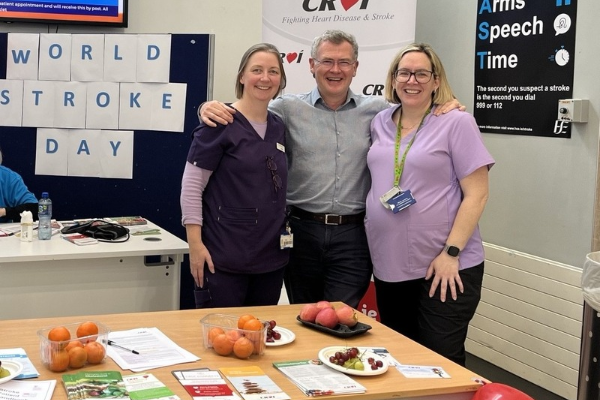
To mark World Stroke Day today (Thursday, 29 October) HSE West and North West is urging Roscommon and Galway people to know the signs of stroke and the importance of seeking treatment as soon as symptoms appear. Strokes are a medical emergency, and urgent treatment is essential. Do not wait for the symptoms to resolve, call 999 or 112 for an ambulance immediately.
1 in 4 of us is at risk of stroke in our lifetimes. A stroke is a life-threatening medical condition, where blood supply to part of the brain is cut off by a blockage or a ruptured blood vessel.
A stroke can happen at any time to any person. It is the third leading cause of death in Ireland and the leading cause of acquired adult neurological disability. Over 90,000 people live with the effects of stroke in Ireland, and it is estimated that there will be a 58% increase in incidents of stroke over the next 10 years.
Recognising the signs of stroke and acting quickly makes a significant difference to survival and recovery. The message is simple: the second you suspect a stroke, is the second you call 999 or 112.
An easy way to be aware of the signs of stroke is to remember the established acronym, F.A.S.T:
- Face – Has the face drooped or become weak on one side?
- Arm – Has an arm become suddenly weak or clumsy on one side?
- Speech – Has speech suddenly become slurred or confused in nature?
- Time – Time to act FAST: phone 999 or 112 for an ambulance immediately.
F.A.S.T. is a well-known worldwide acronym, and yet, there is still some hesitancy when calling an ambulance for stroke symptoms. You only need one of these symptoms for it to be a stroke. Currently, fewer than 50% of stroke patients arrive at the hospital within three hours of symptoms starting a critical window for lifesaving and disability-reducing treatments.
Acting quickly is vital in improving the outcomes of stroke. The sooner a person gets treatment, the less damage is likely to happen.
A stroke can happen at any time to anyone, regardless of age. This is why the newly launched HSE Stroke advertisements focus on everyday family moments, such as playing a game of tennis or hosting a children’s birthday party. The steps stay the same; call 999 or 112 and ask for an ambulance as soon as a stroke is suspected.
Dr Tom Walsh, Consultant Physician in Geriatrics/Stroke at Galway University Hospital (GUH) said, “Stroke is a medical emergency and getting to hospital as quickly as possible is vital. There are two main treatments that have radically improved survival and recovery from stroke by getting the blood flowing back to the brain: Thrombolysis (clot dissolving) and thrombectomy (clot retrieval by transfer to Beaumont hospital).
“However, not everyone will be suitable for these treatments, and timing is critical. Thrombolysis for example must be given within 4.5 hours of symptoms starting. The earlier that treatment begins, the greater the chance of saving brain tissue and reducing the risk of long-term disability or death.”
“Stroke remains one of the leading causes of death and acquired disability in Ireland. It claims more lives than breast, prostate and bowel cancer combined, which highlights just how important it is to recognise the signs and act quickly.”
Mary Gilbert, Clinical Nurse Specialist in Stroke at GUH said, “Every minute matters when someone is having a stroke. Around 2 million brain cells every minute, so delaying treatment can have a lasting impact on a person’s recovery. If you suspect that you or someone else is having a stroke, don’t wait to see if symptoms improve. Call 999 or 112 immediately ask for an ambulance and say that you suspect it could be a stroke.”
For more information, visit www.hse.ie/stroke.
The article above is specific to the following Saolta hospitals::
University Hospital Galway (UHG)